
For decades, the hydraulic hammer has been the default choice whenever a bucket hits rock. But on jobsites where precision, vibration control, and reusable material matter as much as raw force, more contractors and engineers are turning to a different tool: the hydraulic drum cutter.
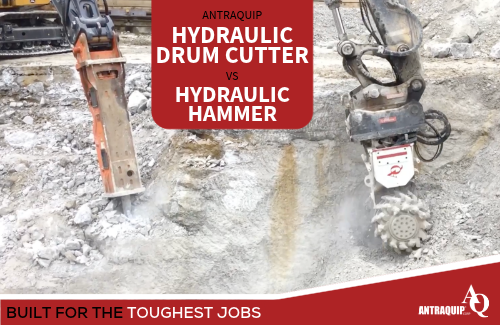
We get this question often: how does a hydraulic drum cutter compare to a hydraulic hammer? A hammer breaks rock through repeated impact. A drum cutter grinds it away through continuous rotation and torque. That difference drives every advantage below.
A hydraulic hammer uses a piston to deliver repeated blows, fracturing rock and concrete through shock force. It's simple, rugged, and effective for mass excavation where the surrounding area can absorb the impact.
A drum cutter uses carbide tipped picks mounted on a rotating drum, driven by a high-torque hydraulic motor. Instead of shattering material, it grinds it away in a controlled, continuous pass. The technology behind Antraquip's cutterheads comes from the mining industry, where precision and continuous production matter more than brute impact.
This is where the difference shows up first. A hydraulic drum cutter holds consistent cutting dimensions and depth, so operators can grind, scale, and trench to a tight tolerance instead of over breaking material and creating rework. On a recent North Carolina project, an AQ-2 ground down the tops of 3,600 concrete footers to a ±3" tolerance without cracking or fracturing the structure below grade. That kind of controlled removal is tough to guarantee with a hammer, where impact energy is harder to meter precisely.
Vibration control is usually a project requirement now, especially near existing structures, utilities, or occupied buildings. Prolonged exposure to high-vibration tools is also a recognized occupational hazard (hand-arm vibration syndrome), pushing more contractors toward lower-vibration equipment for worker safety, not just neighbor relations.
Hydraulic drum cutters produce meaningfully less ground and structural vibration than percussive hammers because they remove material through continuous grinding instead of shock loading. That difference has been the deciding factor on several recent projects:
Noise restrictions have tightened on urban and residential jobsites too. Because hydraulic drum cutters run on continuous rotation instead of repeated impact, they operate at meaningfully lower decibel levels than hammers. That matters on sites with posted noise limits or nearby occupied buildings.
A hammer shatters rock into random, often oversized fragments that usually have to be hauled off site. A drum cutter grinds material into a more consistent, manageable size, and in many cases can be reused as backfill once utility work is complete. That cuts costs to haul away the backfill created and the cost of importing approved backfill.
The math has always favored cutters in the right conditions, and recent projects back it up with real numbers:
Hammers rely on a piston striking a tool bit thousands of times per hour. That's hard on the tool, the undercarriage, and the hydraulic system over time, especially in abrasive, high-UCS rock. Hydraulic drum cutters spread wear across a full set of carbide-tipped picks that spin freely to stay sharp.
None of this makes the hammer obsolete. There are still plenty of jobs where a hammer is the right call. The decision comes down to what the site and the work actually demand.
The case for hydraulic drum cutters is straightforward: better control, lower vibration and noise, reusable material, and higher production. The projects above show it holding up in exactly the conditions where it matters most: dense urban sites, sensitive infrastructure, and hard rock that used to mean reaching for explosives or accepting slow, damaging hammer work.
Curious how a hydraulic drum cutter would perform on your project? Connect with our team


